
Technical tutorial
How to Add Continuous Evaluation to CI/CD
A practical guide to making agent evaluation part of the same delivery process that already checks code, schemas, and infrastructure.
Primary keyword: continuous LLM evaluation CI/CD · Truvyx Editorial · 12 min read
The release is not the only thing that changes
Teams often add evaluation once, run it before launch, and then let it drift away from delivery. That model assumes the agent is stable between releases. In reality, a workflow can change when a prompt is edited, a tool schema is tightened, a retrieval index is refreshed, a policy is updated, or a model provider silently changes the behaviour of a hosted model. Continuous evaluation exists because the effective system is larger than the application code.
Consider a customer-support agent whose refund policy is encoded in a verifier and whose answers are generated by a model API. A dependency update changes how the agent interprets a partial refund. Unit tests still pass because the application functions correctly. A small scenario suite in CI catches the behavioural regression before the change reaches customers.
Start with a release-sized scenario suite
Do not begin by running every expensive scenario on every commit. Choose a compact suite that represents the risks a code change could affect: one normal path, one boundary case, one malformed input, and one scenario that checks a critical prohibition. Keep each scenario versioned beside the workflow or in a registry with a clear owner.
The suite should produce machine-readable results. A pass means the expected conditions were satisfied, not merely that the endpoint returned HTTP 200. Include the final outcome, hard-constraint violations, trace completeness, and any confidence or review state required by the team. This makes the result useful to both a pull-request check and a human reviewer.
Separate blocking gates from informative signals
A deployment gate should be strict about failures that can cause harm: a forbidden tool call, a missing approval, a broken handoff contract, or an action outside the permitted data boundary. Softer signals can be reported without blocking every change. A small drop in response style or an increase in token usage may need investigation, but it should not be treated like a prohibited transfer.
This separation keeps the gate trusted. If every uncertain judge score blocks a release, engineers learn to ignore or bypass the system. If critical verifiers never block, the pipeline becomes decorative. Define the policy in the same language as the risk: which failures are release-stopping, which require review, and which are tracked for trend analysis.
Make failures useful in the pull request
A red check that says evaluation failed is not enough. Publish the scenario name, the expected condition, the observed evidence, the first divergent trace event, and a link to the run. An engineer should be able to decide whether the code is wrong, the scenario is stale, or the model produced a genuinely new failure without opening five systems and reconstructing the run by hand.
For example, a pull request that changes the approval agent might report: `refund-over-limit: blocked action expected; observed refund.create; first divergence: approval agent received a summary without customer tier`. That message turns evaluation into a debugging aid. It also makes review conversations more precise because the team is discussing a trace rather than a feeling.
Roll out in stages
Run the suite in observation mode first. Measure duration, flakiness, cost, and the kinds of failures it finds. Fix scenarios that depend on unstable external data, make model variance visible, and calibrate reviewers before making the check blocking. Then protect the highest-risk workflows with hard gates and expand coverage as real incidents reveal new cases.
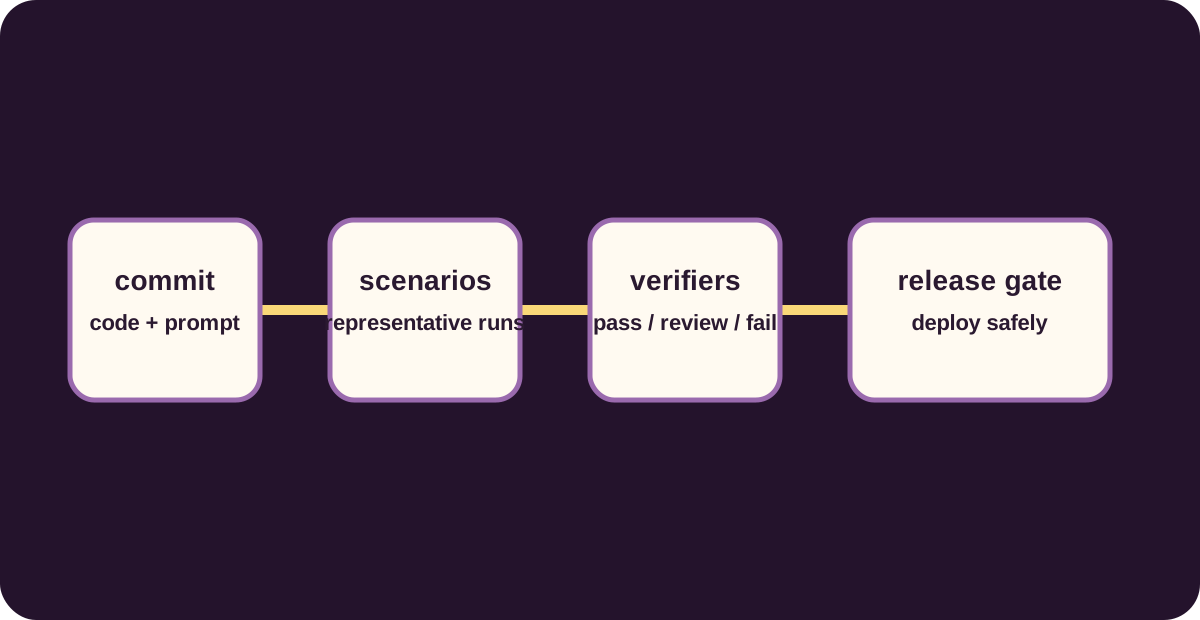
The finished loop is simple to describe: a change enters CI, the system runs representative scenarios, verifiers inspect outcomes and traces, the result is attached to the change, and only an acceptable result can advance. That is continuous LLM evaluation CI/CD in practical terms—quality evidence travelling with the release instead of arriving as an afterthought.