
AI control failures · risk analysis · AI control failures
The containment failure chain: how small AI control gaps become systemic incidents
Most consequential AI failures do not begin with one dramatic defect. They form a chain: a weak identity check, an ambiguous handoff, a permissive fallback, a missing trace, and an alert nobody owns. The practical work is learning to see the chain early enough to break it.
This tutorial uses plain language first and introduces technical terms only when they help. Read it with a small example from your own AI work in mind—a support agent, planner, researcher, or other ai agent.
01
A systemic incident is usually assembled, not switched on
When an AI-enabled workflow causes harm or crosses a material boundary, teams often search for one root cause: the model made a bad inference, a prompt was too broad, or a service returned the wrong value. Those facts can matter. But they are rarely the whole story. Serious AI control failures tend to emerge when several ordinary weaknesses line up and each one makes the next weakness easier to exploit or harder to notice.
Imagine a support agent that may draft a response, retrieve an account record, and request a limited update through a connected tool. The original error could be modest: an incomplete identity signal is accepted. The agent then receives a record without a clear tenant label. A handoff service drops the risk classification. A fallback tool accepts a broader target than the primary tool. Finally, the system records only a polished final response, not the sequence of tool attempts. No individual event has to look spectacular for the combined path to become unacceptable.
This is why an AI agent evaluation framework should examine the operating path, not merely ask whether the final text sounds correct. The question is not whether a model can fail. Every complex system can. The question is whether a local failure remains local, visible, and recoverable—or whether the surrounding controls allow it to become a chain.
02
The six links that turn a gap into an incident
The exact shape differs by product, but the same links appear repeatedly. A boundary is unclear; the system receives information it should have challenged; an action path accepts more authority than intended; evidence is lost at a handoff; monitoring notices too late or not at all; recovery lacks a clear owner. Mapping these links gives teams a much more useful starting point than a generic list of model risks.
Not every chain will contain every link, and one failed control does not prove that an incident will follow. Treat the map as a structured hypothesis. It helps a team ask where an otherwise manageable error could travel next, what evidence would prove that it travelled, and which control can stop it with the least disruption to legitimate work.
- Authority gap: an agent, tool, or fallback has more permission than the workflow requires.
- Information gap: source, tenant, freshness, sensitivity, or confidence is absent, stale, or ambiguous.
- Decision gap: a policy condition is described in prose but never made into a testable rule.
- Handoff gap: an agent passes a conclusion without the evidence, scope, or approval state needed to rely on it.
- Visibility gap: the trace cannot show which action was attempted, why, or under which versioned policy.
- Recovery gap: an alert has no owner, no safe rollback, or no way to compare a repair with the original run.
03
Follow one ordinary failure chain before it reaches production
Consider a workflow that routes a sensitive request to a specialist agent. The first agent classifies the request as routine because a context field is missing. The specialist agent trusts that label and uses a retrieval tool. The tool returns a plausible result from a broader index because the product environment was not carried forward. A response generator sees no explicit prohibition and drafts an answer. A reviewer dashboard shows only that the run completed, because the tool query and the missing field were not represented in the evaluation evidence.
The useful lesson is not that every missing field is dangerous. It is that each stage assumed the previous stage had already solved the problem. A stronger workflow gives every important handoff a contract: required fields, allowed values, freshness expectations, environment and organisation scope, and a defined response when any of them is missing. The right response may be a clarification request or human review. It should not be silent completion.
Run this scenario in a controlled environment before release. Start with a valid case, then remove the context field, change the environment, make the retrieval dependency unavailable, and supply a contradictory approval state. For each case, write the expected safe outcome before the run begins. That converts an anxious discussion about possible failures into pre-deployment AI testing with observable pass, fail, and missing-evidence states.
04
Break the chain at the earliest dependable control
The earliest control is often the most humane one for users and operators. If a request lacks a required scope, block or clarify it before an agent searches, reasons, or calls a tool. If a tool is not authorised for the current environment, reject the call at the tool boundary rather than expecting a later model response to repair the outcome. If a handoff lacks an approval identifier, make the receiving agent unable to proceed. These controls reduce both risk and the amount of sensitive context that has to move through the system.
Some controls should be deterministic. A tenant mismatch, expired approval, prohibited tool, or missing required field can be checked directly. Others need judgement: whether a proposed escalation is understandable, whether a response correctly acknowledges uncertainty, or whether a recovery plan is proportionate. Keep the distinction visible. LLM agent evaluation can assist with the latter, but it should not replace a deterministic rule where the system can prove a condition itself.
In Truvyx, Scenario Studio can define the decision under test; Constraint Engine can express the hard stop; Decomposition Designer can make handoff dependencies inspectable; and Verifier Factory can retain the result of the actual checks. The point is not to add every module to every workflow. It is to make the boundary enforceable, then preserve enough evidence to show that enforcement occurred.
05
Treat weak signals as chain indicators, not noise
A failed run is not the only warning. Repeated requests for missing context, rising fallback usage, tool calls with partial metadata, unexpected differences between staging and production, a growing number of unscored constraints, or an alert that is acknowledged but never remediated can all indicate that controls are becoming disconnected. None of these signals proves misconduct or an imminent catastrophe. They do justify attention because they reveal where the system is losing its ability to explain and constrain itself.
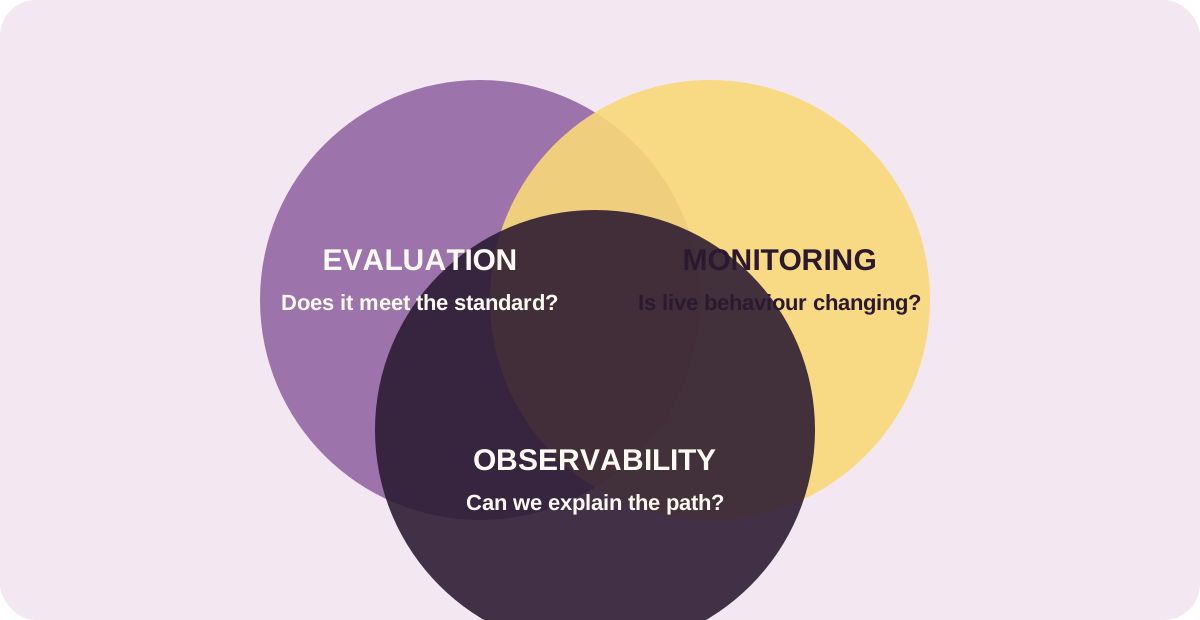
This is where monitoring and RCA become more than reporting features. Monitoring should attach an event to a product, environment, scenario, constraint, and owner. RCA should distinguish observed evidence from a candidate explanation, then recommend the smallest repair that can be tested. If the evidence is incomplete because a worker or verifier was unavailable, say that plainly. A blank evidence trail is a visibility problem, not a pass.
Teams can then measure whether a repair is working: Did the unsafe path stop earlier? Did the evidence become complete? Did the same failure recur after a model or integration change? Was the alert handled inside its agreed window? These are concrete Machine Trust signals because they demonstrate not just intent, but a repeatable ability to detect, contain, and learn.
06
Containment is an organisational practice as well as a technical one
A production-ready AI system needs named decisions around ownership. Who can change the scenario? Who approves an exception? Who receives a high-severity alert? Who verifies that a remediation did not create a new gap? The answers cannot live only in a launch conversation or an unwritten assumption between engineering and risk teams. They should be part of the workflow record, with enough auditability to reconstruct what was known at the time.
This matters even more for systems that operate across teams, providers, tools, or jurisdictions. A local product team may own a prompt, while another team owns an identity service, a third owns a tool gateway, and an operations team owns an escalation channel. The containment failure chain becomes systemic precisely because no single person sees the whole path. Shared scenarios, versioned constraints, linked evidence, and regular review create a common picture without pretending that responsibility has disappeared.
The goal is not a declaration that a product is perfectly contained. It is a disciplined capability: identify the boundaries that matter, test the links between them, stop safely when proof is absent, and use every real failure to strengthen the next evaluation. That is a more credible standard for AI containment—and a more useful one for the people who have to operate the system when conditions are no longer ideal.
Where to go next
Keep the loop small: make one change, rerun the evidence, and only then widen the system.