
AI containment risks · agent systems · AI containment risks
When an AI system escapes its intended role, the failure usually starts at a boundary
Most containment failures do not look like a dramatic escape. They look like a routine action taken with too much authority, too little context, a missing approval, or no reliable way to prove what happened afterward.
This tutorial uses plain language first and introduces technical terms only when they help. Read it with a small example from your own AI work in mind—a support agent, planner, researcher, or other ai agent.
01
An AI system rarely announces that it has crossed a line
The language of an AI system ‘escaping its intended role’ can make the problem sound cinematic. In practice, the first sign is often ordinary. An assistant retrieves a record it did not need. A planner sends a request to a tool without carrying forward a required constraint. A fallback service completes an action that the primary path would have blocked. A retry keeps trying after the original condition has changed. Each event can look small when viewed alone.
Containment risk appears when the system’s actual behaviour exceeds the purpose, information, or authority that the team believed it had. That can happen without an obviously malicious model response. It can emerge from a useful feature connected to an over-scoped tool, a handoff that silently omits context, an integration that treats a missing check as success, or a dashboard that reports one green number while several critical facts are unknown.
For a team building production-ready AI, the useful question is not ‘could the model ever do something surprising?’ Nearly any complex system can surprise its operators. The useful question is: what are the boundaries of this specific product, how will we observe a boundary crossing, and what will the system do before the crossing becomes an irreversible action?
02
Containment risk begins with authority drift
Authority drift happens when an agent’s practical power grows beyond the job it was designed to perform. It is not always the result of a single permission change. A support agent may begin with read-only access to account information, then acquire the ability to call a workflow that creates a ticket, then gain a connector that can update an account, then inherit a broadly scoped service credential because it is convenient during integration. The product description may still say ‘assistant,’ even while the system has become an operator.
The safest design separates observation, proposal, authorization, execution, and verification. The agent can inspect a bounded set of information and make a recommendation. A policy or approval layer decides whether the recommendation is permitted. A narrowly scoped executor performs the approved action. An independent check verifies what changed. This separation makes it harder for a fluent response to become an unreviewed act.
An AI agent evaluation framework should test the seam between those roles. It should submit cases where the recommendation is reasonable but the authority is absent, expired, outside the chosen environment, or too broad for the proposed action. A contained system does not compensate for absent authority with a more persuasive explanation. It stops, explains the unmet condition, and sends the case to the correct owner.
03
Five containment risks that hide inside normal agent workflows
The first is information-boundary failure. An agent sees data from the wrong tenant, a restricted field, an irrelevant historical record, or a source that its task did not require. The output may still look helpful. That is precisely why the input boundary needs to be explicit, enforced by the data layer, and tested with cases that prove a sensitive or unrelated record is not retrieved.
The second is tool-boundary failure. A tool can be called with an unintended target, parameter, or environment. A system that is allowed to draft an action may accidentally receive the permission to execute it. Give every sensitive tool a narrow vocabulary and an execution scope that can be inspected later. A model’s stated intent is not a sufficient authorization mechanism.
The third is handoff-boundary failure. In a multi-agent workflow, the receiving agent may act on a summary that has dropped the caveat, approval state, source, deadline, or uncertainty that made the original information safe. Handoffs should have required fields and versioned contracts. When a field is missing, the next agent should be unable to quietly infer it.
The fourth is recovery-boundary failure. Retries, model fallbacks, and provider switches are valuable operational features, but they can alter behaviour. A retry may run after a decision has become stale. A fallback may not share the original model’s capabilities, cost profile, or safeguards. Recovery must be bounded by attempt count, time, scope, and an explicit stop condition.
The fifth is oversight-boundary failure. A system can technically escalate a difficult case but send an unusable alert, omit the evidence a reviewer needs, or leave ownership unclear. A nominal human-in-the-loop process is not containment unless the right person receives a comprehensible record in time and can meaningfully intervene.
- Information: the agent receives data outside its permitted scope
- Tools: the agent can perform an action beyond its intended authority
- Handoffs: a required condition disappears between agents or services
- Recovery: retries or fallbacks continue after the safe operating context changes
- Oversight: a human escalation exists in theory but cannot prevent or explain the action
04
A realistic scenario: the approval that vanished in transit
Consider an agent system that triages a sensitive customer request. A first agent gathers the case, a policy agent determines that senior approval is required, and a response agent prepares the final outcome. The policy agent does its job correctly. It sets the approval state to pending and attaches a reason. During a later handoff, however, the receiving agent gets only the proposed outcome and the customer identifier. It sees no approval field and sends the result anyway.
The visible symptom is a final message that should not have been sent. The underlying containment risk is not simply that the last model was careless. The system allowed a critical state to be optional at a boundary. A response-level prompt reminder may reduce the frequency of the failure, but it does not establish control. A durable repair makes approval evidence a required input to the executor or response path, blocks the action when that evidence is absent, and records the reason for the block.
This is the kind of example that should appear in a pre-deployment test suite. Run the complete case with valid approval, then run it again with the approval field removed at the handoff. The expected result in the second case is an observable stop or escalation, not a lower-quality answer. That distinction makes the test useful to engineering, risk, and operations at the same time.
const handoffContract = {
  required: ["case_id", "risk_tier", "approval_state", "policy_version"],
  allowedApprovalStates: ["APPROVED", "PENDING", "REJECTED"],
  executeOnlyWhen: "approval_state === APPROVED",
  onMissingField: "BLOCK_AND_CREATE_REVIEW_RECORD"
}
05
Why a safety score cannot contain a system on its own
A safety score can help a team compare runs, but it is a summary of the checks that were actually performed. It cannot tell you whether an untested tool was exposed, whether a missing trace hid a failed check, or whether a downstream service acted after the evaluation finished. For that reason, a high aggregate score should never be read as blanket permission to widen authority.
Machine Trust asks for a more demanding record. Which scenario version was used? Which constraint was tested? Which evidence supports pass or failure? Was a hard rule not scored? Which product and environment produced the action? Who approved an exception? Did the worker or evaluator itself fail? These questions can feel procedural until an incident occurs. Then they are the difference between an investigation and a guess.
The UK AI Security Institute has emphasised the need for rigorous evaluation of misuse safeguards and for testing claims against evidence. That framing matters for ordinary enterprise AI too. Safeguards are not established because a product page says they exist. They are established to the extent that their behaviour can be tested under representative and adversarially chosen conditions, including cases where a control is absent or degraded.
06
Turn containment risk into an evaluation plan
Begin with a short boundary inventory for one product. List the user-visible purpose, the information sources it may access, the tools it may call, the actions that require approval, the conditions that must block execution, the people who own escalations, and the logs or evidence that prove each decision. This is not busywork. It is the raw material for scenarios, constraints, verifier checks, and monitoring configurations.
Then create three examples for each meaningful boundary: a normal request that should pass, a near-boundary request that should escalate or request more evidence, and a broken-boundary request that must be stopped. Include the ugly operational cases as well: a stale handoff, a slow tool, an unavailable provider, a missing identifier, and an environment mismatch. A useful containment test proves not only that the system can do its job, but that it remains legible when it cannot.
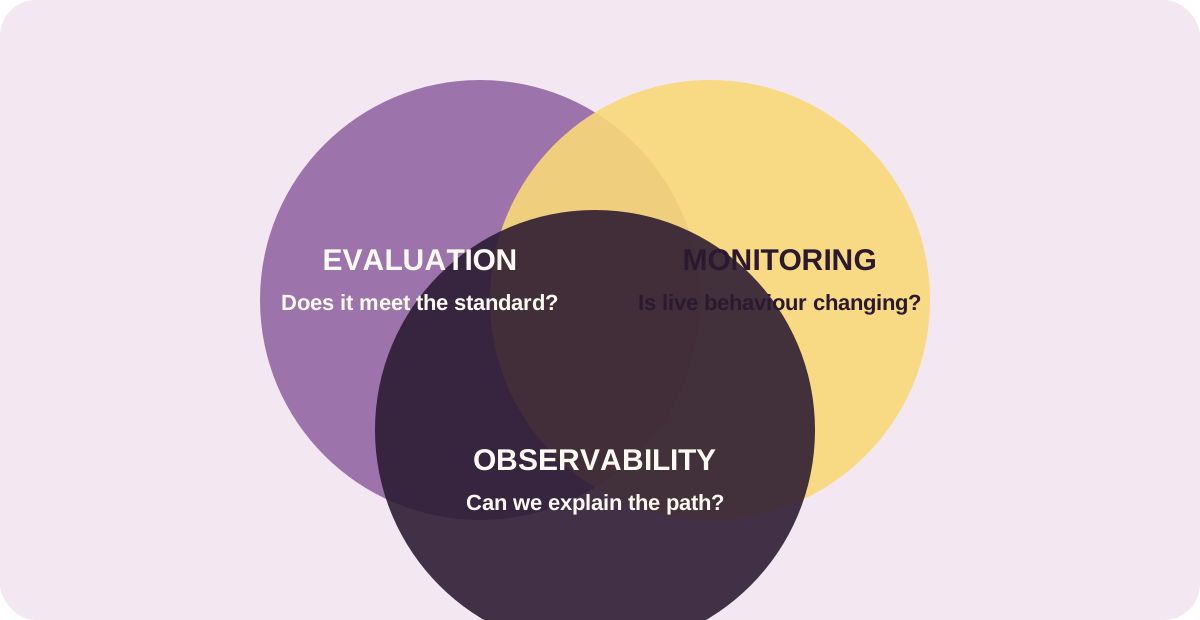
In Truvyx, use Products & Connections to anchor the system and environment, Scenario Studio to capture the operating question, Constraint Engine to define hard boundaries, and Verifier Factory to make checks reproducible. Use the run detail to inspect evidence, RCA to separate a symptom from a candidate cause, and Monitoring to keep the boundary under observation after deployment. That is a continuous loop, not a one-time certification exercise.
07
The goal is controlled capability, not zero capability
Containment is sometimes misread as a demand to make AI systems less useful. The opposite is true when it is done well. Clear boundaries let teams grant useful authority with less guesswork. A support agent can draft confidently within a documented policy. An operations agent can propose a repair while a bounded executor verifies the target and approval. A research assistant can help a scientist find material while access and review controls preserve the conditions for responsible work.
The alternative is often brittle caution or unbounded convenience: either the system is blocked from useful work because nobody can describe a safe path, or it is given broad access because each exception is handled informally. Both are difficult to operate at scale. Containment creates the middle ground: enough capability to serve the intended purpose, enough structure to stop at the edge, and enough evidence for a person to understand what happened.
That is how a team should recognise containment risk. Do not ask whether the system sounds safe. Ask what it can actually reach, what it can actually do, what must be true before it acts, what happens when that proof is missing, and whether someone else could verify the answers from the record. If those questions are hard to answer, the boundary has not yet been built.
Where to go next
Keep the loop small: make one change, rerun the evidence, and only then widen the system.