
AI containment · production governance · AI containment
AI containment is the missing layer between powerful models and safe deployment
A capable model is not automatically a safely deployable system. AI containment is the set of technical, operational, and human controls that keeps an agent inside its intended authority—and leaves enough evidence to prove what happened when the boundary is tested.
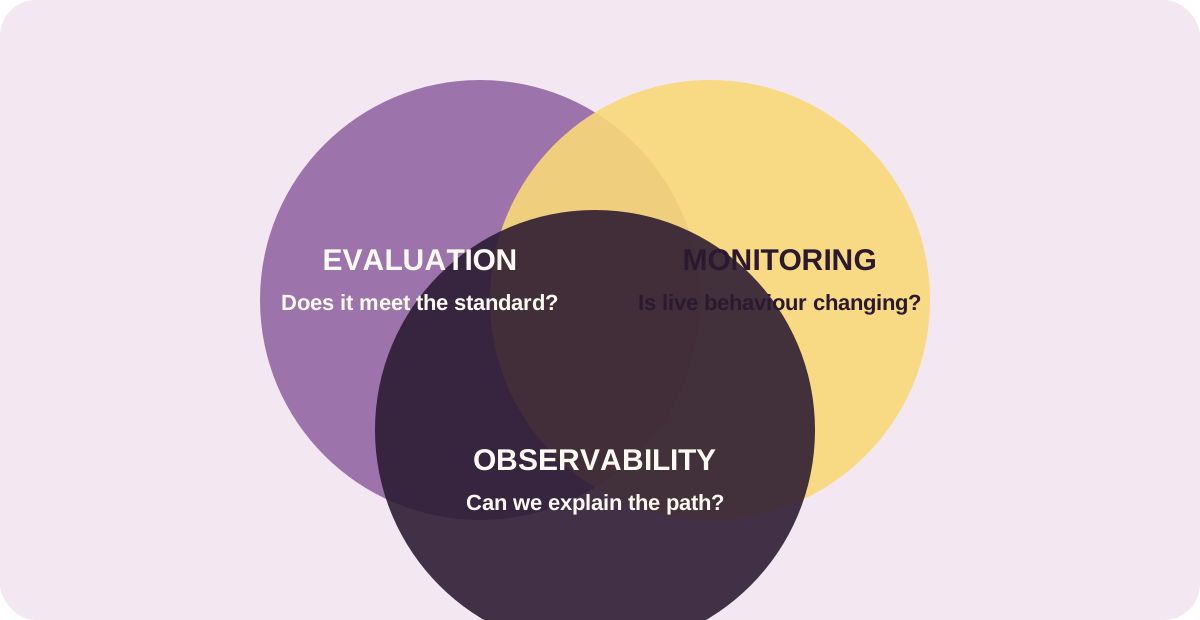
This tutorial uses plain language first and introduces technical terms only when they help. Read it with a small example from your own AI work in mind—a support agent, planner, researcher, or other ai agent.
01
Containment is not a refusal message
When people hear AI containment, they often picture a model refusing an unsafe request. Refusal matters, but it is only one moment in a much larger system. A production agent may search internal documents, call a workflow, retrieve a record, delegate work to another agent, send a message, or write to a downstream service. The meaningful question is not merely what it says. It is what it is allowed to know, decide, call, change, and repeat—and what stops it when the answer is unclear.
That is why a useful definition of AI containment is layered: the system has a stated purpose; narrowly scoped authority; constraints around data, tools, timing, and decisions; evaluation before and after change; monitoring in operation; and a human path for the cases that cannot be safely resolved by automation. Each layer reduces a different kind of risk. None should be mistaken for a guarantee on its own.
A customer-support assistant illustrates the difference. It may be permitted to summarize a known policy and draft a response. It may be forbidden from changing account access, revealing a restricted field, or deciding an exceptional case without review. A prompt can state those rules. Containment exists only when the surrounding system also limits the accessible tools and data, checks the resulting action, records the relevant evidence, and escalates when a required condition is absent.
02
Why AI containment becomes urgent when the model can act
A chat interface generally has a small immediate blast radius: an answer may be wrong, but a person still decides what to do next. An agentic workflow changes that equation. Once a system can trigger tools, make handoffs, operate on live data, or carry a task across several steps, a plausible-looking mistake can become an operational event. The risk is often in the chain rather than a single sentence: a weak identity check, a permissive tool scope, an omitted handoff field, and a retry without a stop condition can combine into a result no one intended.
This is also why containment cannot be borrowed wholesale from traditional access control. Access control answers who may call a resource. AI containment also asks whether the agent’s current objective, context, evidence, sequence, and proposed action make that call appropriate now. A service account may have technical permission to update a record; the agent should still be blocked if it cannot demonstrate the prerequisite approval or if its scenario says the case must be escalated.
The NIST AI Risk Management Framework describes risk management as a continuous lifecycle activity organised around governing, mapping, measuring, and managing risk. That is a more useful mental model than a one-time safety review. A deployment is contained only to the extent that those controls remain effective as the model, prompts, tools, data, and operating context change.
03
The five boundaries a production AI system needs
Start with purpose. Write down the decision the system is allowed to assist with and the outcome it is not allowed to decide. This prevents capability from quietly becoming authority. A research agent may gather sources and identify uncertainty; it should not independently publish a sensitive conclusion or extend its own remit because it found an adjacent task it could perform.
Next comes information. Define which data sources, classifications, tenants, and fields are in scope. A system must not infer that access to one customer record permits it to retrieve a neighbouring customer’s record, or that a useful answer justifies exposing a restricted detail. The boundary needs to be enforced by the data and tool layer, then tested in evaluation rather than assumed from a policy document.
Then define action. Give agents the smallest practical set of tools and parameters. A useful action boundary records a target, a command class, a rate or cost limit, a time limit, and an expiry. It also distinguishes proposing an action from executing it. The person or service that grants authority should be able to explain why this exact action was allowed in this exact context.
The fourth boundary is process. Multi-agent systems need explicit handoffs, required fields, dependency checks, retry limits, and approval points. A safe outcome cannot depend on an unspoken assumption that another agent remembered a detail. If a verifier requires approval evidence before a result is sent, the handoff that carries that evidence must be visible and testable.
Finally, define recovery. Decide in advance what happens after a failed check, delayed tool, unavailable provider, contradictory input, or missing evidence. A bounded retry may be acceptable. A fallback may be acceptable under a documented constraint. A silent continuation is often not. Recovery needs an abort condition, a record of the attempted action, and a route to a human when the system has reached the edge of its authority.
- Purpose: what decision the system may support and where its remit ends
- Information: which data, fields, tenants, and sources are permitted
- Action: which tools, targets, parameters, rates, and time windows are allowed
- Process: which handoffs, dependencies, approvals, and checks must occur
- Recovery: which failures can retry, which must stop, and who reviews them
04
Containment needs evidence, not confidence
A team can be confident that its system is well designed and still be unable to show what occurred during a disputed run. Machine Trust begins where confidence stops: with a record that another person can inspect, challenge, reproduce, and govern. For a consequential action, the useful record links the product and environment, scenario version, constraints, verifier version, agent output, permitted trace references, tool outcomes, human approvals, and terminal result.
Evidence also protects the team from a familiar failure mode in AI operations: turning unknown into success. If a worker did not process a run, if a verifier timed out, or if a trace never arrived, the dashboard should say unavailable, pending, partial, or not scored. A green status based on missing information is not containment. It is an observability gap wearing the costume of assurance.
This distinction is especially important when teams use model-based judges. A language model can help assess semantic questions, but it cannot replace a deterministic check for a missing approval, an unauthorised tool call, a cross-tenant identifier, or a budget limit. Give deterministic rules deterministic evidence. Use model-assisted judgement where the question is truly semantic, calibrate it against human review, and retain the rubric that produced the result.
const containmentGate = {
  rule: "approval before high-impact action",
  type: "HARD",
  evidenceRequired: ["approval_id", "approved_at", "actor_scope"],
  ifEvidenceIsMissing: "BLOCK_AND_ESCALATE",
  audit: "preserve_original_run"
}
05
How to test containment before an agent reaches production
Pre-deployment AI testing should include an ordinary case, a boundary case, and a case designed to prove the system stops. The ordinary case checks whether the workflow can complete its intended task. The boundary case checks whether it recognizes incomplete authority or ambiguous evidence. The stopping case checks whether it refuses, blocks, or escalates when a hard constraint cannot be satisfied. All three should be part of the same AI agent evaluation framework, not separate demos prepared for different audiences.
For example, a claims workflow can be tested with a complete, low-risk submission; a high-risk submission that includes all required review evidence; and a high-risk submission where that evidence is missing. The desired outcome in the third case is not a clever answer. It is a visible block or escalation with an explanation of the unmet condition. The evaluation should then inspect the action log and tool trace to confirm that the agent did not proceed by another route.
This is where scenario-led evaluation becomes practical. In Truvyx, create a product and environment, define the scenario, add hard constraints across safety, data governance, temporal, dependency, and optimisation categories, generate a verifier, and submit representative outputs. If a run fails, preserve it, inspect constraint-by-constraint evidence, and use RCA to form a testable hypothesis. The repair is only complete when the same boundary case passes for the right reason and a regression or monitoring rule protects against recurrence.
06
Containment risk is usually a systems problem
It is tempting to attribute an unsafe outcome to a single model failure. Sometimes that is true. More often, the model is the visible end of a chain: the prompt did not state the policy clearly; a tool exposed more authority than the task needed; an orchestrator dropped a required field; a provider fallback behaved differently; monitoring noticed the issue too late; or a reviewer received no usable evidence. The containment risk lies in the interaction among those layers.
That is why teams need more than a benchmark score. They need to be able to ask: Did this failure concentrate in one product, environment, model, tool, or agent role? Did it begin after a deployment? Did the evaluator fail, or did the agent? Has a human been repeatedly overriding the same output? Is the apparent pattern supported by enough evidence to change a control? Those are operational questions, and they require linked source records rather than a summary chart alone.
A mature response is deliberately unglamorous: narrow the failing surface, identify the first unexpected event, make one controlled repair, rerun the same scenario, record the result, and add durable coverage. It is slower than a broad prompt rewrite in the moment, but it is the path that accumulates trust instead of repeatedly rediscovering the same risk.
07
High-consequence domains need humility as well as controls
AI containment is relevant across ordinary business systems, and it matters even more where a system could affect critical services, sensitive data, financial decisions, public communication, or dual-use knowledge. In those contexts, a high score should never be described as proof of safety. It is evidence about the scenarios that were actually tested, the controls that were actually observed, and the uncertainty that remains.
The same discipline applies to biosecurity and other high-consequence areas. The World Health Organization frames biorisk management and dual-use research governance as shared responsibilities across the life-science ecosystem. An AI product can contribute a limited, valuable piece of that work by enforcing scoped access, preserving evidence, requiring qualified review, and testing safeguards. It should not claim to solve a societal risk that depends on institutions, expertise, law, physical security, and responsible practice beyond the model itself.
This is the difference between a safety claim and a trustworthy operating posture. The first asks the reader to believe the system is safe. The second shows which boundaries are in place, how they are tested, where evidence is incomplete, and who has the authority to decide when the system should stop.
08
Start with one contained decision
Do not begin by trying to contain every capability a general-purpose model might have. Start with one product decision that your team can describe clearly. Identify the purpose, the data it may use, the action it may take, the evidence it needs, and the person who takes over when the rule cannot be satisfied. Build one passing case and one safe-stop case. Then review the records with the people who own the product, risk, and operations.
That small exercise often reveals the real work. You may discover that the product has no stable environment label, that a tool is over-scoped, that an approval has no durable identifier, that an output cannot be traced to a scenario version, or that nobody owns an alert. Those are not reasons to abandon the project. They are the beginning of a containment programme that is real enough to be tested.
Powerful AI systems do not become safe because a policy exists somewhere in the organisation. They become more governable when intent, authority, evidence, and recovery are connected in the actual path from request to action. That is the missing layer between an impressive demo and a production-ready AI system.
Where to go next
Keep the loop small: make one change, rerun the evidence, and only then widen the system.