
Foundations
Evaluation vs Monitoring vs Observability for AI Systems
These three practices answer different questions. Confusing them leaves teams with plenty of telemetry but no reliable way to decide whether an AI system is safe to release.
Primary keyword: AI evaluation vs monitoring · Truvyx Editorial · 12 min read
Why the words get mixed together
An engineering team may say that its AI system is monitored because it collects latency, token counts, errors, and traces. Those signals are valuable, but they do not tell the team whether a new agent version can complete a meaningful task without violating a rule. Another team may call a collection of benchmark prompts an evaluation suite, even though it never checks tool calls, handoffs, or production drift.
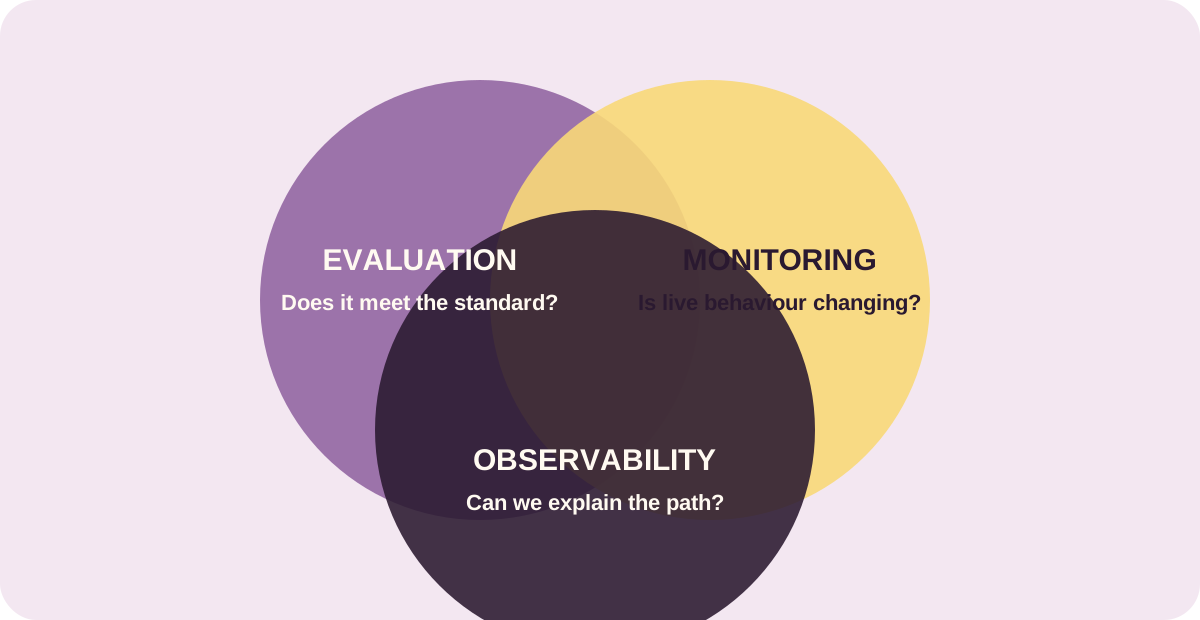
The confusion is understandable because all three practices involve evidence. The difference is the question each one is designed to answer. Evaluation asks whether the system meets a defined standard. Monitoring asks whether live behaviour is changing or crossing an operational threshold. Observability asks whether the available evidence is rich enough to explain what happened inside the system.
Evaluation is a controlled question
An evaluation starts with a scenario and an expected standard. You might ask whether a claims assistant correctly routes a suspicious claim, preserves the customer’s information boundary, and explains the decision. The scenario can be run against a candidate model, a changed prompt, or a new orchestration graph before release. The result is a decision about quality, safety, or readiness.
Evaluation works best when it is repeatable. A scenario library captures normal cases and difficult boundaries; deterministic verifiers check rules that should never be negotiable; rubric or model-based judges handle qualities such as clarity; and a trace records the evidence. This is the centre of an AI agent evaluation framework because it tests the workflow before the real customer is placed in it.
Monitoring is a live signal
Monitoring begins after the system is running. It watches for changes such as rising failure rates, longer trajectories, unusual tool usage, cost spikes, or an increase in human escalations. In a support workflow, a monitoring alert might show that the average number of agent turns doubled after a provider update. That signal does not explain the cause, but it tells the team that something deserves attention.
Monitoring thresholds should reflect the risk of the workflow. A harmless drafting assistant can tolerate a different error budget from an agent that can issue refunds or change production infrastructure. The threshold is a trigger for investigation, not a substitute for the evaluation that established what good behaviour looks like in the first place.
Observability explains the path
Observability is the evidence design that makes a system understandable from its outputs. For AI, that means more than logs. Engineers need agent identity, prompt or policy version, retrieved context references, tool calls, handoffs, constraint checks, retries, latency, and state transitions. Without those links, a dashboard can announce a failure while leaving the team to guess which component caused it.
Imagine that a monitoring alert reports a fall in successful appointment bookings. Evaluation tells you whether the current system still passes a known scenario. Observability helps you discover that the scheduling agent is receiving a timezone-normalised date while the booking tool expects local time. The three practices work together, but none of them can replace the others.
Design the three as one operating loop
Use evaluation to define and protect the behaviour you want, observability to make each run explainable, and monitoring to notice when live conditions depart from the expected envelope. When monitoring finds a new pattern, promote a representative incident into a scenario. When evaluation exposes a weakness, improve the trace so the next failure is easier to diagnose.
This operating loop keeps the product team from treating AI quality as a one-time benchmark score. Models change, tools change, policies change, and users discover new paths. A mature AI evaluation platform connects pre-deployment evaluation to post-deployment monitoring without pretending that a green dashboard means the system is universally correct.