
Technical guide
How to Detect Behavioural Regressions After a Model Update
A model update can preserve uptime while changing the decisions, tool calls, tone, or safety boundaries that matter to your product. Here is how to catch the change deliberately.
Primary keyword: LLM regression testing · Truvyx Editorial · 12 min read
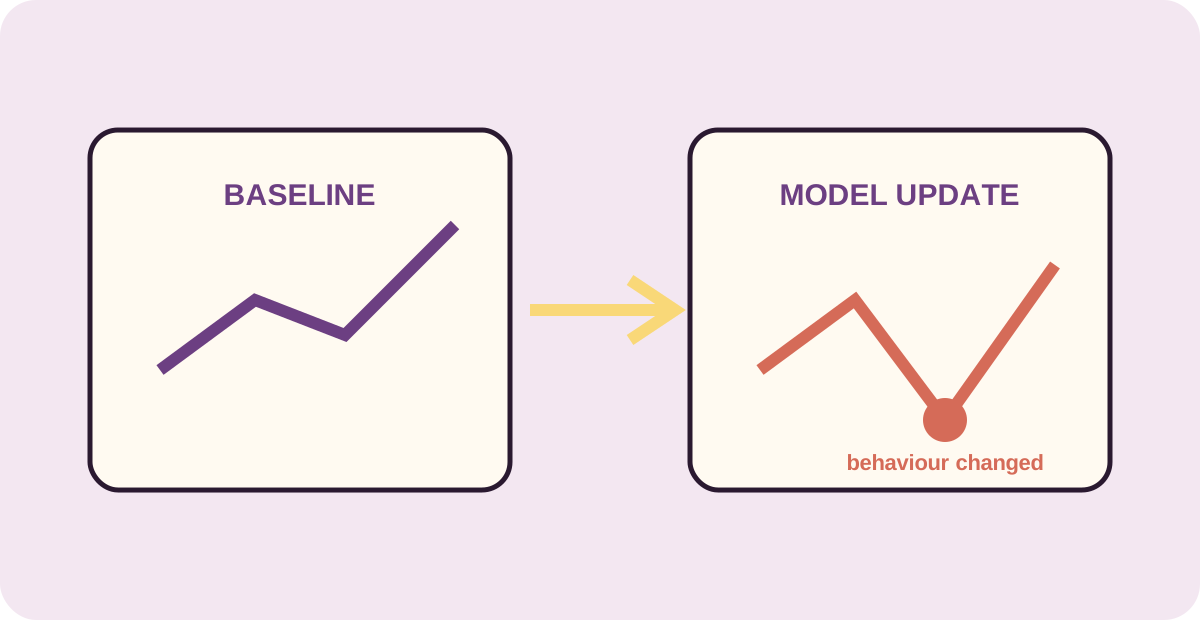
A successful request can still be a regression
Operational dashboards tend to celebrate availability. If the endpoint responds quickly and the request does not throw an exception, the update looks healthy. But an AI system can regress while remaining perfectly available. It may stop asking for a required field, choose a more expensive tool, expose a detail that used to be private, or produce a confident answer where it previously escalated.
Take a finance assistant that classifies expense claims. Before the model update, ambiguous claims went to human review. After the update, the assistant approves more claims and the average latency improves. Those numbers look good until someone notices that the new model interprets a missing receipt as evidence that the purchase was personal. The regression is behavioural, not infrastructural.
Define what must remain invariant
Regression testing begins by naming the behaviour that must not change. Some invariants are hard: never call a payment tool without approval, never reveal a restricted field, always preserve a required handoff field. Others are quality expectations: classify a known case correctly, explain the decision, use the least-privileged tool, or escalate uncertainty.
Store the baseline with enough context to reproduce it: model identifier, prompt and policy versions, scenario version, tool fixtures, evaluator versions, and trace references. Without that context, a comparison can be misleading. A changed scenario may look like a model regression, while an altered judge may make a stable run appear different.
Compare trajectories, not only final answers
A final-answer diff is a useful first view, but it misses the path. Compare agent selection, handoff contents, tool order, retrieved evidence, constraint outcomes, number of turns, and final decision. A response can be textually similar while the system took a riskier route to reach it. Conversely, wording can change substantially while the decision and evidence remain correct.
Use a layered policy for differences. A prohibited tool call or changed decision on a critical scenario should fail immediately. A harmless wording change can be recorded as a variation. A new escalation may require review rather than automatic failure. This is why LLM regression testing needs a scenario-aware evaluator instead of a string comparison alone.
Reproduce before you blame the model
When a regression appears, rerun the scenario with fixed inputs and controlled tool responses. Check whether the difference survives more than one run. Then inspect the trace: did the model change, or did a retrieval document, tool response, timeout, or orchestration branch change first? Reproduction prevents teams from applying a prompt patch to a problem caused by test data or infrastructure.
Once the cause is understood, keep the case. A regression scenario is valuable because it records an exact boundary that the product team now knows matters. Add the expected decision, the critical evidence, the allowed alternatives, and the reason the case is important. Over time, the suite becomes a memory of the system’s hardest lessons.
Make model updates reviewable
Treat a model change like a dependency change with a compatibility report. Run the critical suite before and after the update, group differences by severity, and ask an owner to approve intentional changes. If a new model is better at one task but worse at a regulated workflow, the answer may be routing rather than a blanket upgrade.
The goal is not to freeze the agent. It is to make change visible. A reliable team can adopt a stronger model quickly because it knows which scenarios protect the product, which differences are acceptable, and where a human must decide. That is the practical value of regression monitoring for AI: turning silent model drift into an explicit engineering conversation.