
Bioaccess risk · systems analysis · bioaccess risk
Bioaccess risk: why controlling information alone is not enough
A system can refuse a sensitive question and still create a serious control gap if the wrong person can reach the wrong data, invoke the wrong tool, inherit the wrong approval, or leave no usable evidence. Bioaccess risk is the problem of the whole access pathway.
This tutorial uses plain language first and introduces technical terms only when they help. Read it with a small example from your own AI work in mind—a support agent, planner, researcher, or other ai agent.
01
Bioaccess is about the pathway, not one answer
Content controls are visible. A user asks a question, the model answers or declines, and the interaction appears easy to evaluate. But an AI product is rarely only a chat window. It may retrieve data, call external services, coordinate specialist agents, use a memory store, or hand a recommendation to a human workflow. In that setting, the practical question is not only what information appears in a final response. It is who can move through the whole pathway, with which permissions, under what conditions, and with what accountability.
This is what we mean by bioaccess risk: the risk that an AI-enabled system broadens practical access to sensitive biological capabilities or resources without sufficient context, safeguards, and oversight. The term is deliberately broader than information risk. Information matters, but so do identity, tool access, agentic coordination, environment, persistence, and the ability to turn a recommendation into a real-world action.
The distinction helps teams avoid an unhelpful binary. They do not have to choose between unrestricted access and blanket refusal. They can design layered pathways that preserve legitimate, authorised use while making unsafe, ambiguous, or unverified paths difficult to complete and easy to investigate.
02
The seven control surfaces of a bioaccess pathway
A useful review begins by drawing the path from a user request to any consequential result. Include the user or service identity, the product and environment, the data sources, model provider, agents, tools, approvals, output destination, monitoring, and escalation route. The map will usually reveal that a policy attached to the model is only one of several controls.
The goal is not to make every workflow cumbersome. It is to apply stronger controls where access, autonomy, or consequence rises. A user who needs a high-level explanation may need a very different pathway from a workflow that can query restricted material or trigger an external service. The controls must remain understandable to users and maintainable by operators, or they will be bypassed in practice.
- Identity: establish which person, service, organisation, and role is making the request.
- Purpose: bind access to a legitimate, documented task rather than a generic account permission.
- Information: scope retrieval by source, classification, tenancy, freshness, and redaction policy.
- Tools: permit only the narrow actions, targets, and parameters needed for the approved workflow.
- Handoffs: carry required evidence, scope, approval state, and uncertainty between agents or services.
- Oversight: define when the system should stop, ask for context, or route a case to a qualified human.
- Evidence and recovery: preserve minimum useful metadata, alert an owner, and support a safe investigation and rollback.
03
A content refusal cannot repair an over-permissioned system
Suppose an assistant declines a sensitive request correctly. That is a useful result. Now imagine that a retrieval agent already searched a broad index before the refusal, or that a connected tool used an inherited service credential with wider authority than the current user should have. The final message may look safe while the underlying pathway has still crossed an important boundary. The right remediation is not to make the refusal sound firmer. It is to correct the access design.
This is why agent systems need explicit scope at every tool boundary. The system should know the organisation, product, environment, permitted source classes, allowed tool, approved target, and expiry of the authority being exercised. If any required element is absent, stale, or contradictory, the safe default is a hold or escalation—not a broad fallback to whatever the underlying service happens to permit.
In practice, that means avoiding shared, all-purpose credentials where a scoped capability can be used. It means that a development connection should not quietly reach production resources. It means a secondary provider or retry pathway must obey the same policy as the primary path. And it means that a successful tool response is not itself evidence that the tool call was authorised.
04
Model the pathway as a testable scenario
Begin with one feature and one intended user journey. In Scenario Studio, record the product, environment, user role, legitimate objective, authorised data sources, connected tools, expected output, and human escalation route. This becomes the stable object that later runs, evidence, monitoring, and remediation can refer to.
Then write several cases that reveal whether the boundary is real. An ordinary authorised case should succeed. A case with a missing organisation scope should stop or ask for clarification. A case with an expired approval should not inherit permission from an earlier step. A case where a tool is unavailable should defer safely rather than select a broader unapproved alternative. These cases do not need sensitive biological detail; they test the system’s access logic and decision discipline.
Use Constraint Engine for the conditions that cannot be negotiated at runtime. For example: the request context must match the connected resource; an unapproved tool may not be called; required review evidence must exist before a restricted workflow continues; and a missing trace makes the result not scored. These rules turn a vague promise of careful access into an AI agent evaluation framework with inspectable outcomes.
05
Verify both the decision and the route taken
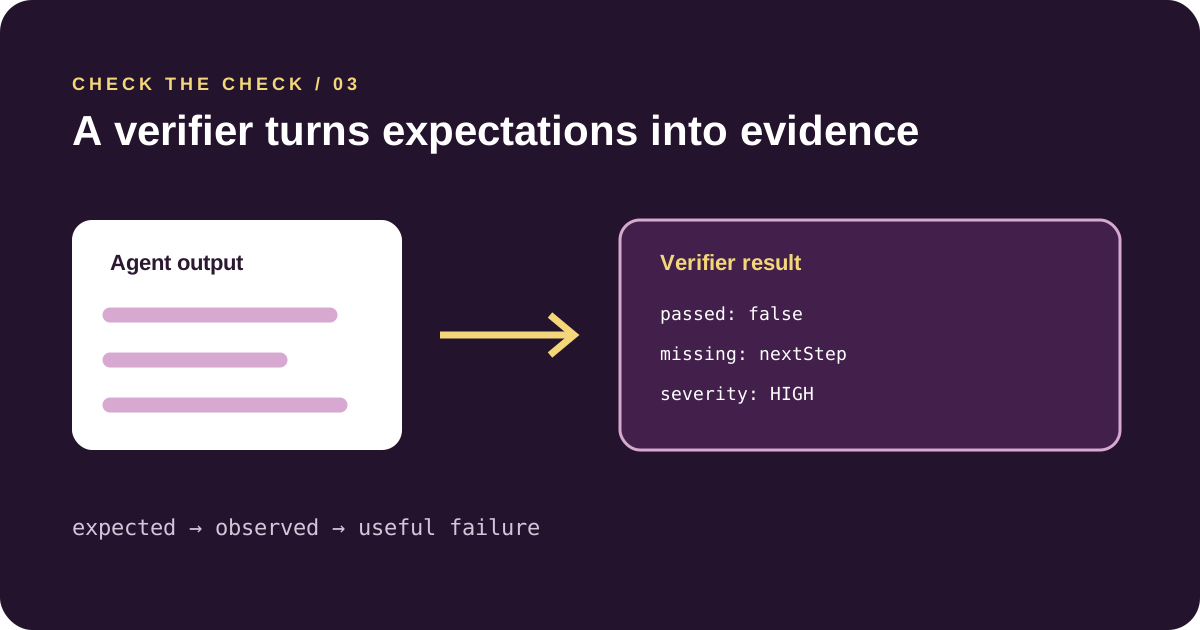
A final answer cannot tell you whether the system followed the intended route. Verification should capture enough structured evidence to establish which policy was applied, which agent or service acted, which tools were attempted, whether a boundary condition was met, and what happened when it was not. It should avoid duplicating raw sensitive content when metadata, redaction, or hashing can answer the operational question.
Some checks are straightforward: does the run carry the expected organisation and environment, did the tool name match the allowlist, was an approval current, did a forbidden call occur, was a reviewer assigned? These belong in deterministic verifiers. Other checks require qualified human judgement, such as whether an escalation explanation gave the reviewer enough context without oversharing. Keep the two kinds of evidence distinct rather than hiding them behind a single score.
The result should say passed, failed, or not scored for each meaningful constraint. Not scored is an important state. It may mean that evidence was missing, a worker was unavailable, or a connected verifier could not complete. Treating it as a pass creates a false picture of containment precisely where visibility is weakest.
06
Human review is a designed capability, not an escape hatch
Some requests will be genuinely ambiguous. A well-designed system should not force the model to improvise a high-stakes judgement merely to keep the interaction moving. It should create a bounded handoff: explain at a high level why more context or review is needed, preserve the relevant policy state, send the case to the right queue, and prevent follow-on actions until the decision is resolved.
The reviewer needs a useful packet, not a raw transcript dump. Show the product and environment, the request classification or reason code, the policy or constraint involved, the actions attempted, the redaction state, and the decision needed. Define a response window and an owner. When the reviewer decides, store the outcome and use it to improve the scenario, policy guidance, or routing rules if the same ambiguity recurs.
This also gives teams a way to measure whether escalation is working. Are cases reaching the right owners? How long do reviews take? Are reviewers consistently accepting or rejecting a category? Do automated checks agree with qualified human judgement? HITL Analytics can make those questions visible without turning reviewer work into an unstructured exception queue.
07
Monitoring turns access policy into an operating system
Access controls can degrade after launch. A new integration may add a tool; a provider fallback may be configured without the same scope policy; a model update may change how an agent responds to uncertainty; an administrator may widen a role to solve a short-term problem. Monitoring should look for these changes in the real product context, not only for a drop in an aggregate quality score.
For a high-consequence pathway, monitor events such as blocked tool attempts, missing-scope stops, abnormal escalation volume, unscored verification, unexpected fallback use, policy-version drift, and repeated boundary failures. Attach each signal to a product, environment, scenario, owner, and evidence record. If an alert fires, it should say what changed, which boundary was involved, whether a run can be inspected, and what the next safe action is.
When a failure occurs, use RCA to separate observations from hypotheses. Fix the narrowest demonstrated gap, rerun the original case, and retain it as regression coverage. The aim is not to prove that a system will never create risk. It is to ensure that access remains bounded, observable, and governable as the system evolves.
Where to go next
Keep the loop small: make one change, rerun the evidence, and only then widen the system.